
Amid accelerating geopolitical shifts, institutional activity, and rising international recognition, Uzbekistan in particular has become a significant site for the production of new cultural narratives. The increasing visibility of artists from the region within biennials, museums, research platforms, and international collections reflects not only a growing market interest, but also a broader reconsideration of how contemporary art histories are constructed, circulated, and institutionalized beyond traditionally dominant centers.
This presentation, developed by FORA Gallery in collaboration with partner-curator Bekzod Ulmasov, brings together a selection of artists whose practices reflect the complexity and diversity of contemporary artistic production emerging from Uzbekistan today. Positioned between inherited cultural memory and rapidly transitioning market realities, the works presented examine questions of identity, materiality, migration, mythology, ecology, gender, labor, and the politics of representation through distinct approaches.
Operating within a broader post-Soviet and post-colonial condition, the artists included in this presentation negotiate layered relationships between local histories and global contemporaneity. Their practices resist simplified ethnographic readings, remaining attentive to the cultural specificities of the region. Textile traditions, ritual systems, and collective histories emerge continuously reinterpreted across their work. The growing international recognition of contemporary Uzbek art has developed alongside key institutional initiatives and expanding cultural infrastructures. Projects such as the Bukhara Biennial, the increasing presence of Central Asian artists at major international exhibitions, and the growing engagement of collectors and institutions with the region signal a shift toward new forms of cross-regional dialogue.
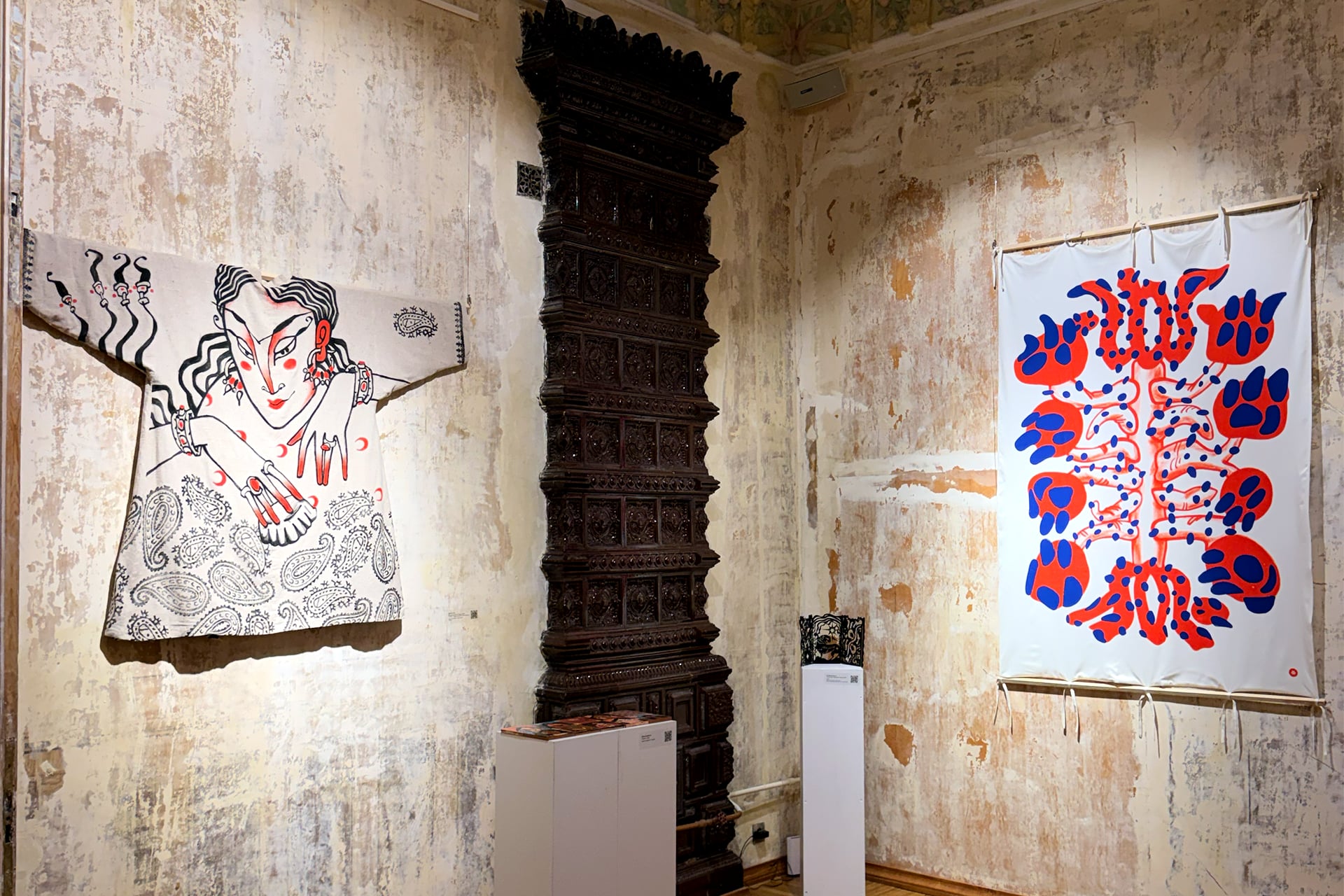
Within this context, Dilyara Kaipova reconfigures traditional Uzbek textile technologies through the visual lexicon of mass culture, producing layered works in which ikat, embroidery, and fabric operate as carriers of historical, ideological, and political meaning. Her practice challenges distinctions between craft, contemporary art, and popular imagery, proposing textile as both archive and critical language through which questions of history and identity are materially inscribed.
Similarly engaging with material as a site of memory and transformation, Munisa Kholkhujaeva approaches artistic practice through systems of interdependence, ecological philosophy, and sensory research. Working across textile, drawing, installation, ceramics, and performative formats, Kholkhujaeva constructs environments that investigate biological cycles, decentralized modes of coexistence, and non-hierarchical relationships between human and non-human life. Kholkhujaeva has participated in numerous international and regional projects, including her collaboration with the Central Asian research collective DAVRA and Saodat Ismailova for documenta 15 in Kassel, her work in the Bukhara Biennial, and projects developed within the framework of the Uzbekistan Pavilion at the 2021 Venice Architecture Biennale, alongside other institutional platforms.
The practice of Zi Kakhramonova introduces another dimension of contemporary Uzbek artistic production through the intersection of mythology, feminist inquiry, theatricality, and urban research. Combining textile, digital animation, performance, metalwork, and scenographic thinking, Kakhramonova constructs immersive visual narratives that blur distinctions between folklore and speculative futures. Her participation in the Uzbekistan National Pavilion at the 61st Venice Biennale further underscores the increasing international recognition of a new generation of artists from the region.