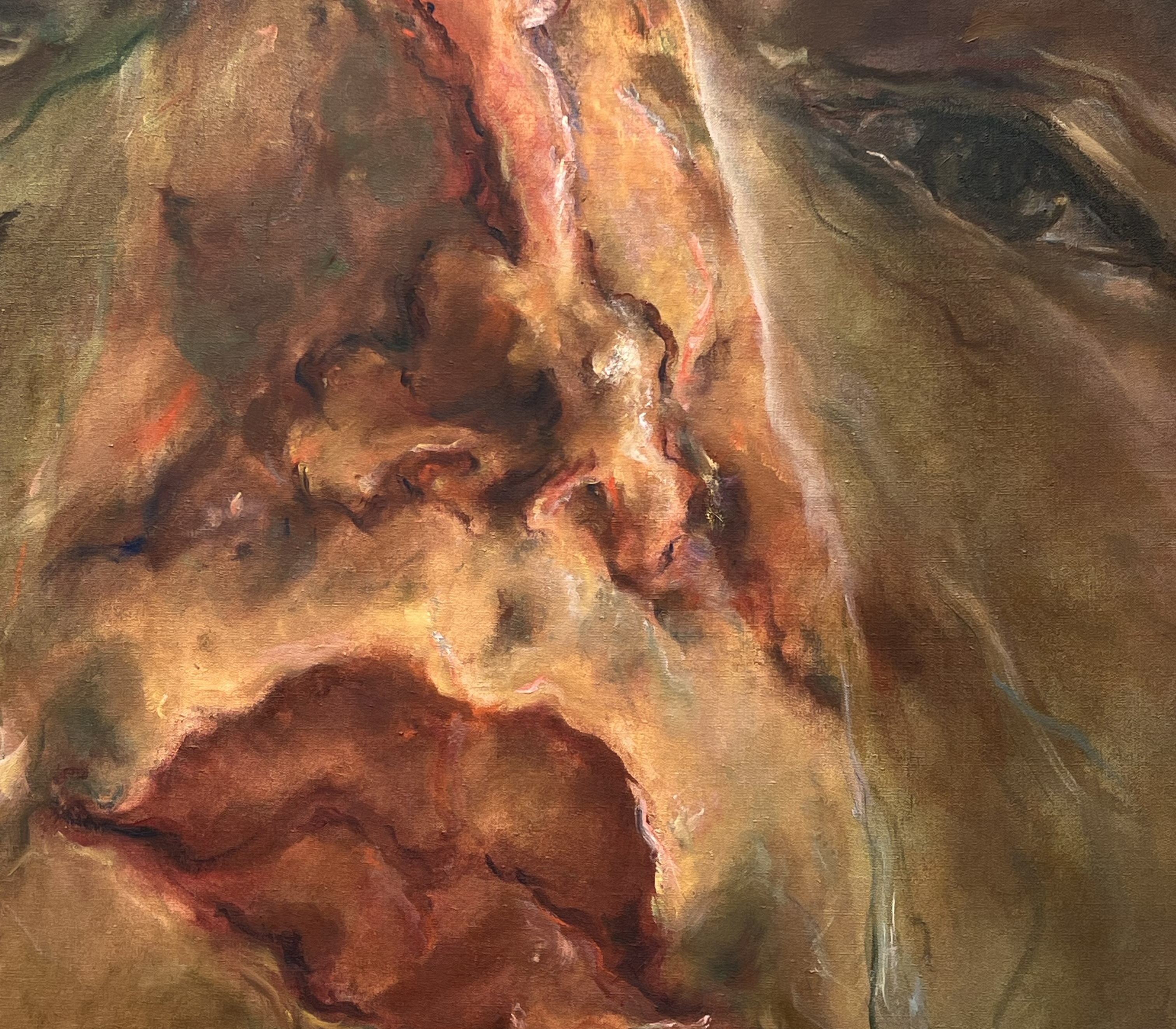
The inaugural edition of Art Basel Qatar was set into motion as a carefully engineered discursive environment, where the institutional cliché of a “global dialogue” was made structurally visible. What is often invoked in contemporary art rhetoric: the meeting of cross-regional currents and locally embedded practices was here realised through spatial, curatorial, and narrative logic. The fair staged regional production as co-author of a multi-sited conversation.
For the MENASA region, the implications extend beyond mere visibility, as the fair establishes new channels for influence circulation - not simply toward the region, but from it. With its public days aligning with the 2026 edition of India Art Fair, Art Basel Qatar affirms an independent model of cultural influence for the region.
The fair opened with Jenny Holzer’s ‘SONG’ (2026), projected across the façade of the Museum of Islamic Art.
Layering the voices of Mahmoud Darwish and Nujoom Alghanem into a monumental public text work accompanied by drone choreography, the work situated the fair within the symbolic architecture of the city. The effect was declarative: Doha’s civic and cultural landmarks, from the National Museum of Qatar to Souq Waqif, were positioned as contributors to an active contemporary dialogue.
If the opening suggested the fair’s ambitions, its program made them operational. The nine site-specific commissions across Msheireb Downtown (the largest group of new commissions in any Art Basel iteration to date) functioned as generative formats of contemporary art production. Under the artistic direction of Wael Shawky, the program oscillated between monumentality and performative intimacy, from Hassan Khan’s digitally mediated musical systems to collaborative performance practices that foregrounded the body as both archive and instrument. In this context, site-specificity became about institutional authorship with the fair itself acting as commissioning body, curator, and constituting a narrative framework.
Extending this institutional logic into the discursive sphere, the Conversations program at M7 brought together leading and active figures across global and regional art patronage, art management, creative practice, and curatorial theory, highlighting how artists, institutions, and patrons collectively shape today’s cultural landscape.
The most structurally and conceptually significant aspect of the gallery presentations was their curatorial coherence.
In contrast to the visual saturation that often defines large-scale fairs, Art Basel Qatar emphasized narrative clarity and spatial pacing. Solo presentations established a shared rhythm across the fair, reinforcing the conceptual framework of “Becoming”. This allowed each showcase to become part of a collective narrative, with galleries contributing to a shared dialogue rather than competing for the spotlight.
This was particularly evident in the first gallery level of M7,
where presentations by Hauser & Wirth, White Cube, and Acquavella created an axis linking post-war modernists, blue-chip contemporary practice, and regionally grounded conceptual production. Works by Basquiat, Guston, Marwan, El Anatsui, Baselitz, Picasso, and Sophia Al-Maria did not read as isolated market trophies, but as works placed in deliberate historical and conceptual dialogue.
The second floor extended this logic into media hybridity, with Kutluğ Ataman’s ‘The Stream’, and Gallery 2 presentations, notably Marlene Dumas at David Zwirner, reinforcing the conceptual interest in psychological and material intensity.
The Design District expanded the fair’s immersive dimension.
Here, color, light, and construction logic produced a more sensory experience. Particularly notable were works by Aiza Ahmed (Sergent’s Daughters), Souad Abdelrasoul (Gallery Misr), Lina Gazzaz (Hafez Gallery), Maryam Moseini (Green Art Gallery), Yunchul Kim (Barakat Contemporary), Katsumi Nakai (Luxembourg + Co), and Alvaro Barrington (Sadie Coles HQ). Local production by selected artists, together with the strong regional context shaping their works, appears to have encouraged experimentation with new formats and material strategies, signaling a new trajectory for global art fair models as active catalysts of contemporary artistic production.
Ultimately, Art Basel Qatar enters the global agenda as a structurally and conceptually exceptional platform, boosting new directions and tendencies across global fair ecosystems.
At Fora Gallery,
we empower collectors and art enthusiasts by providing comprehensive information and expert guidance to navigate art fairs with confidence. From discovering standout works presented by leading galleries and collections, to advising on the most considered purchases and assisting with the acquisition process.
We act on behalf of our clients internationally, being present on-site, communicating directly with galleries, and supporting the purchase of works. We ensure a seamless and informed experience, offering support throughout every stage of our clients’ engagement.