As women and female-led initiatives increasingly trace the global art landscape, the focus shifts beyond mere visibility. At Fora Gallery, we continue to engage with practices that foreground the evolving modes of regional representation, and recognize their growing influence within a wider international context.
On the occasion of the 61st edition of La Biennale di Venezia, we speak with Farah Piriye Coene – independent curator, art consultant, cultural producer, and co-founder of Zeitgeist19.
Her multidisciplinary practice traverses contemporary art and cultural inquiry, bringing artists, researchers, and practitioners into dialogue. Her work examines the interdependence of environmental and social systems, grounded in cross-border exchange and attentive to the intersections of history, migration, memory, identity, and ecology.
In the final days before the special opening on May 9, Farah takes us backstage at Santi Cosma e Damiano on Giudecca. Joined by the Zeitgeist19 team, co-curator Elizabeth Zhivkova, participating artists, and her infant son in her arms, she offers a glimpse into the processes behind the exhibition, where the context of the Biennale comes into sharper focus.
Titled ‘In Minor Keys’, the 61st edition of La Biennale di Venezia was curated by Koyo Kouoh
as a transnational framework that rethinks exhibition-making through collective production, expanded geographies, and non-hierarchical forms of relation. Developed prior to Kouoh’s passing in May 2025 and realized posthumously by La Biennale di Venezia, the exhibition brings together 110 artists, duos, collectives, and artist-led initiatives across diverse contexts.
Presented across the Giardini, the Arsenale, and multiple sites throughout Venice, it proposes a recalibration of attention toward what often remains peripheral or overlooked.
Within this framework, the official collateral event of the Biennale, ‘AS ABOVE, SO BELOW’,
opens on Guidecca. Organized by One Ocean Foundation and conceived by Zeitgeist19, it is curated by Elizabeth Zhivkova and Farah Piriye Coene. The project brings together artists and collectives working across sound, moving image, immersive environments, and research-based practices.
Exceeding traditional formats, the exhibition operates as a dynamic platform, informed by public dialogue and cross-disciplinary collaboration. Realized through the curatorial and operational framework of Zeitgeist19 – a female-led curatorial collective engaged with underrepresented narratives – it progresses across residencies, site-responsive artistic production, and direct encounters with planetary ecologies.
As Piriye Coene notes, the exhibition seeks to act like the ocean.
It is structured in moving layers of new forms of knowledge – sensory and embodied – echoing interconnected systems of life, where human and non-human worlds are understood as co-dependent.
Listening, attuning, and sensing here become key methods and forms of perception. Data is displaced from purely statistical frameworks toward lived, experiential registers. In this way, the project works to reduce the psychological distance between individuals and the natural systems they inhabit.
The title draws on the Hermetic principle of correspondence, situating oceanic, terrestrial, technological, and human systems within a shared continuum. Instead of a vertical hierarchy between the “above” and the “below,” the exhibition presents a horizontal field of relation, where signals circulate across bodies, scales, and contexts.
The venue is presented as an acoustic and sensorial setting unfolding through acts of listening. Fabbrica H3 is a former church, later converted into a textile factory and now an experimental venue. Its layered architecture embodies a history of continuous transformation. Here, sound, light, and data function as carriers of comprehension, recalibrated through proximity and attention within the scope of the project.
Among the presented works, several projects engage directly with oceanic intelligence.
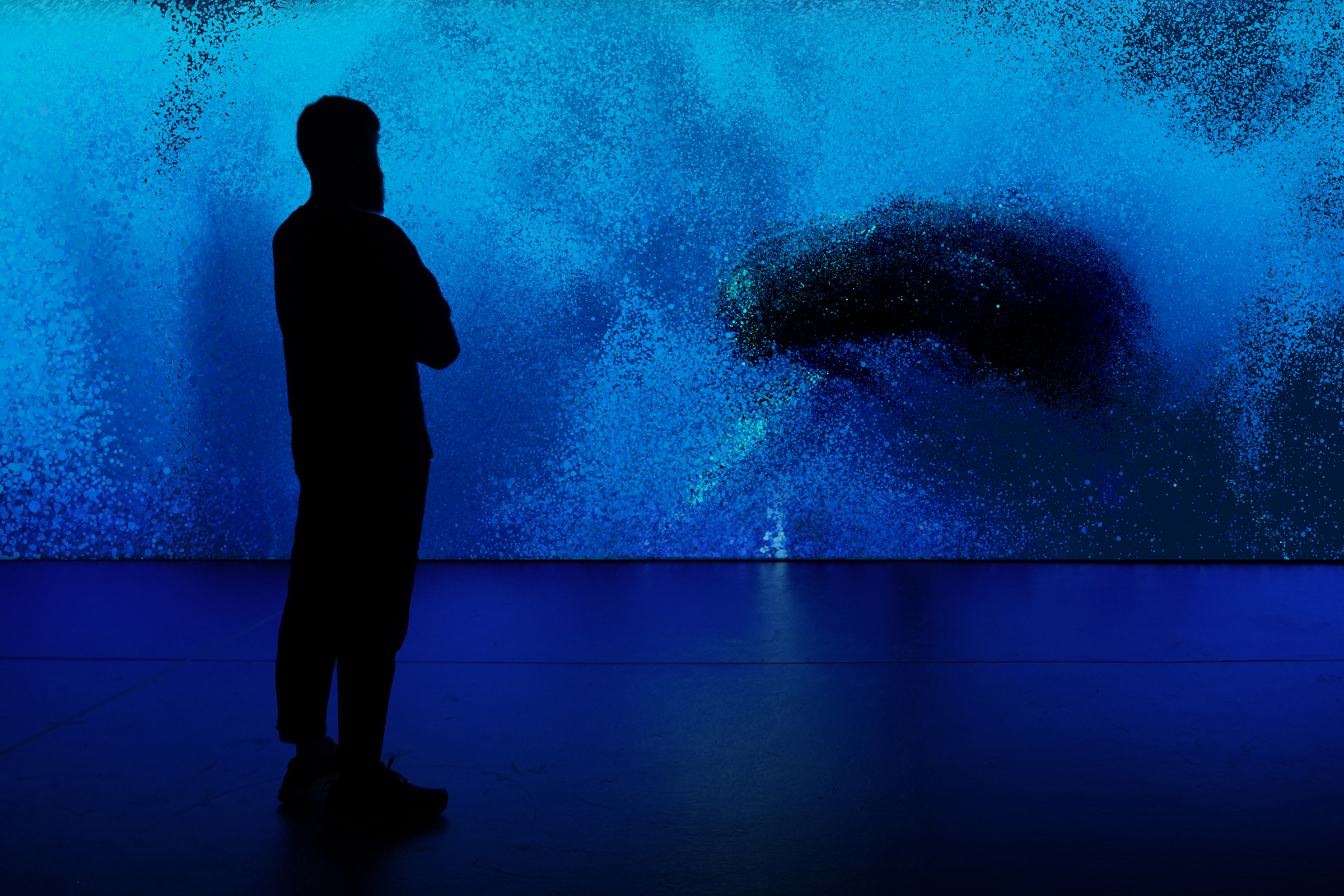
London-based artist collective Marshmallow Laser Feast presents ‘Seeing Echoes in the Mind of the Whale’, an immersive 17-minute single-channel video installation with 5.1-channel audio. It is positioned where an altarpiece would traditionally stand. Created in collaboration with filmmaker Tom Mustill and with scientific support from the UPC Bioacoustic Applications Laboratory, the work invites visitors to sit beneath the space’s classical frescoes and immerse in the sensory world of cetaceans. It renders the echolocation of bottlenose dolphins, humpback whales, and sperm whales.
Antoine Bertin’s ‘Fish String Theory’ extends this inquiry through a listening installation. Comprising hydrophones, sculptural fish forms, tensioned strings, and a machine-listening system it incorporates a large language model. The work was initiated through the project’s artist residency in Venice, during which Bertin spent time listening to the acoustic life of the Giudecca lagoon. It was further developed through the Te Ataata Residency Programme at Villa Antipode. The work makes audible the so-called “kwa” sound produced by scorpionfish in Mediterranean seagrass meadows – a chorus heard by coastal communities for decades without known origin.
Other works attend to water as archive and cosmological matter.
‘Water Older Than the Sun (Caspian)’, a multimedia installation by Almagul Menlibayeva and Suad Gara. It situates the shrinking Caspian Sea within composite histories of extraction and memory. A central cybertextile, combining Central Asian traditional weaving with AI manipulation, depicts hovering between human and non-human, while AI-processed documentary footage unfolds across screens. Suad Gara’s accompanying film ‘Requiem for the Caspian’ is a single-channel documentary co-produced by Zeitgeist19, grounding the concept of ecological collapse in lived experience. An original score by Reinhold Heil, heard through headphones, threads the work’s registers together.
Yoko Shimizu’s ‘Tides of Light: Meadows of the Abyss’ continues the exhibition’s inquiry. It is a single-channel video installation developed through the project’s artist residency and field research programme aboard the ONE Catamaran, organized by One Ocean Foundation and Zeitgeist19. Developed in dialogue with the work of marine biologist Sylvia Earle, the piece meditates on bioluminescent plankton, and approaches luminescence as a form of language, born from direct encounter with the sea.
Within the nave, works by artists from Azerbaijan expand the exhibition’s inquiry toward non-human communication systems.
Elnara Nasirli’s ‘Whispering Forest’ is a sensorial, site-responsive installation. It comprises a reclaimed olive tree, custom electronics, sensors, bone-conducting sound, and wiring. Bioelectric rhythms are translated into melody, made fully perceptible only through touch, proximity, or embrace. The work enacts the curatorial gesture at the heart of the exhibition: to slow down, to come close, and to explore the boundaries between the human body and the natural world. Orkhan Mammadov’s ‘Conversations with Nature’s Memory’, is a dual-screen generative installation with AI and sound created specifically for the exhibition. It extends this reading, foregrounding the fungal networks, rendering visible systems of communication that are constant, vast, and almost invisible.
Andrea Crespi’s ‘Thetis’, a holographic work created for the exhibition by One Ocean Foundation and Zeitgeist19, completes the exhibition’s arc. A translucent jellyfish hovers within the vitrine, placed in deliberate dialogue with the venue’s frescoes. Here, digital form becomes a means for transmitting.
Set within the fragile ecosystem of the Venetian lagoon, on view from 9 May to 8 June 2026, ‘AS ABOVE, SO BELOW’ proposes a subtle yet critical shift: from observation to relation, from information to knowledge, from urgency to attentiveness.