
Almagul Menlibayeva
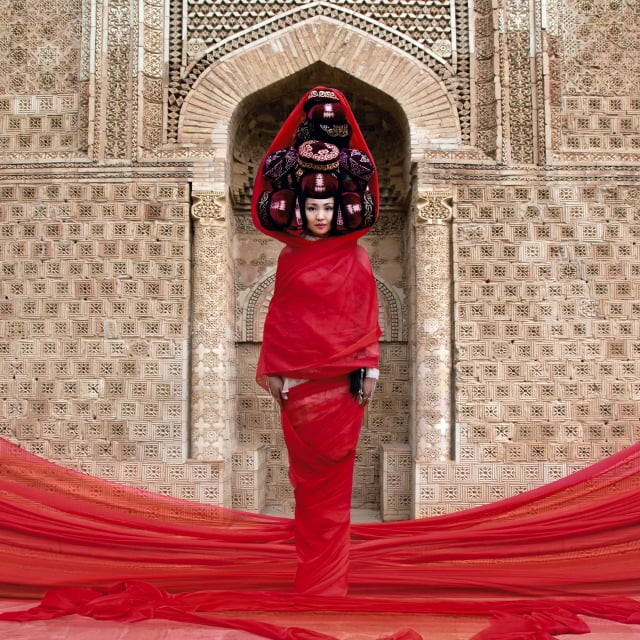
Fieldwork and archival inquiry are important components of Menlibayeva’s methodology. She has worked extensively across Kazakhstan, particularly in regions influenced by Soviet industrialization, environmental extraction, and the Gulag system. Her long-term projects connected to Karaganda and Karlag revisit the histories of political repression, forced deportation, and multicultural displacement that reshaped the region throughout the twentieth century. Collaborating with local communities, historians, researchers, and filmmakers, she combines documentary material, staged cinematic imagery, immersive sound, and textile structures to create layered installations where historical and speculative narratives coexist.
Underlying the artist’s research-driven practice is a sustained re-reading of Central Asia beyond the inherited geopolitical narratives. Additionally, Menlibayeva’s projects frequently examine collectivization, ecological catastrophe, famine, forced displacement, nuclear histories, and the ideological transformation of the region from a historical center into a perceived periphery. Drawing connections between the Caspian region, Siberia, the Silk Roads, the Caucasus, and the Middle East, the artist resists simplified definitions of Central Asia as a singular or static geography. Instead, her works construct fluid cartographies shaped by empires, trade dynamics, ecological shifts, and cultural exchange.
“Revisiting the past makes it possible to understand the present and to project the future. If your past has been constructed by others, the ability to make choices or effect change becomes limited.”
Editorial Features

04.05.2026
In Focus for La Biennale di Venezia 2026: AS ABOVE, SO BELOW
The official collateral event of the Biennale, organized by One Ocean Foundation and conceived by Zeitgeist19, curated by Elizabeth Zhivkova and Farah Piriye Coene, opens on Giudecca on May 9
18.12.2025
Almagul Menlibayeva on Art and Freedom
From the legacies of Kazakh Craft to a nuanced perspective on the Region