The 2026 edition of Art Basel arrived not as a spectacle of certainty, but as a structured act of reassessment. 290 galleries from 43 territories, 90,000 visitors from 103 countries, and a market that had learned, through several years of correction, to mean what it placed on the walls. The fair worked within its conditions — and in doing so produced an edition that felt more coherent than many of its predecessors.
This edition established something more durable than a strong week of transactions: it reaffirmed the fair’s function as the primary site where the art market takes stock of itself — not only from its established centres of gravity, but increasingly from the peripheries that are, with each edition, becoming less peripheral.
Basel is structured as an argument for continuity.
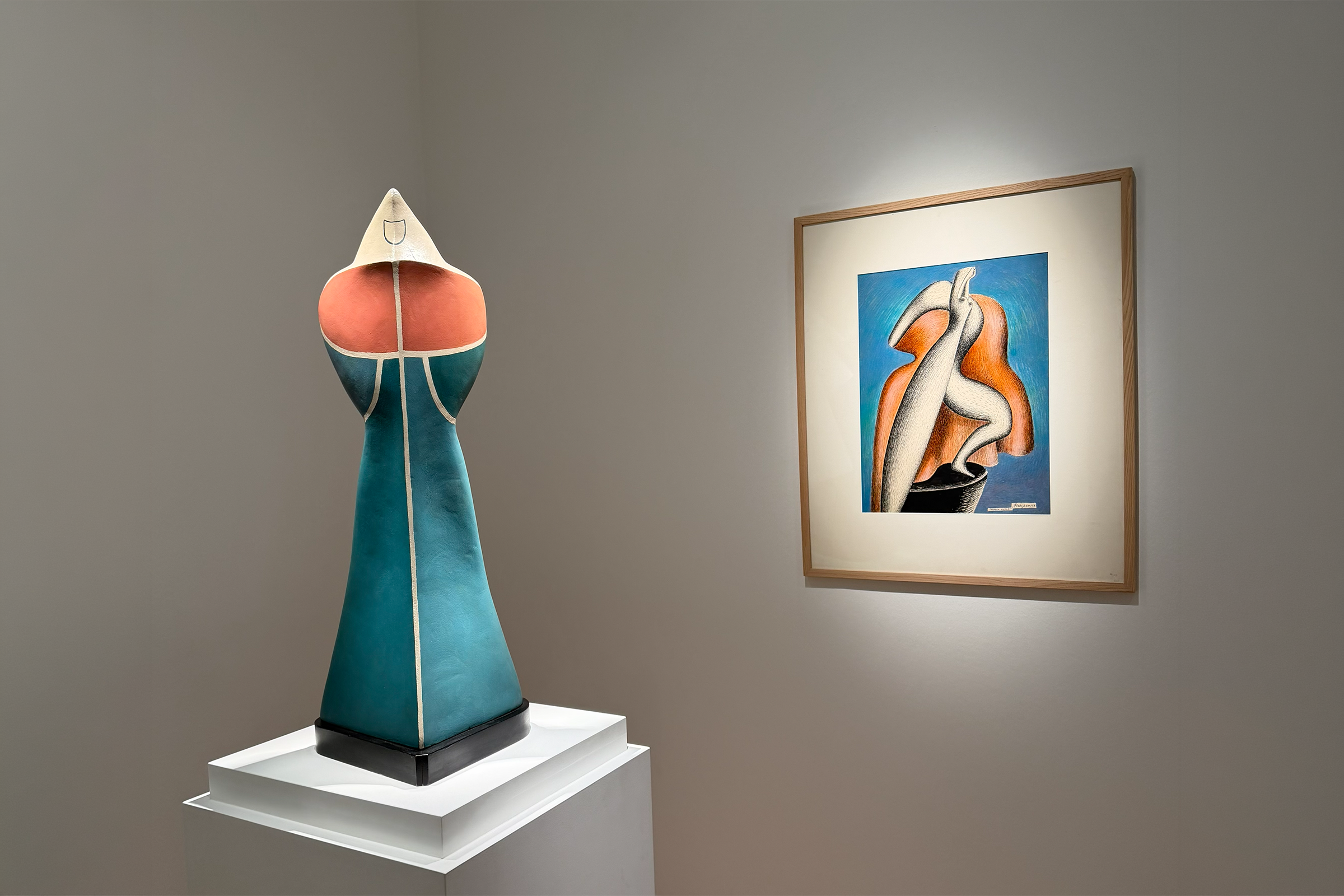
The main Galleries sector brings modern masters into direct proximity with leading contemporary artists, while Feature is devoted to curated historical presentations of 20th-century practice — a space where the foundational figures hold their ground. Among them, Alexander Archipenko: the Cubist sculptor who treated empty space as a positive element, carving the void into form and reshaping what sculpture could be. The same lineage runs through Le Corbusier, who arrived at architecture through painting, co-founded Purism with Amédée Ozenfant as the rigorous successor to Cubism, and carried that discipline into a body of built work that redefined how the century lived. Showing historical, modern, postwar, contemporary, and emerging practices within a single exhibition, the fair offers a snapshot of the global art scene at one moment in time. The contemporary stars draw the crowds. But it is the presence of the builders — the inventors of the schools — that gives the fair its depth and reminds visitors where the conversation began.
The fair’s opening hours were defined by the weight of recent loss.
David Hockney, who died on June 11 at the age of 88, was present throughout the week in a way that exceeded the commercial. GRAY’s booth carried his Studio Interior #2 (2014), sold for $8.5 million. Georg Baselitz, who died on April 30, was similarly honoured — Thaddaeus Ropac placed his Ach, Mädchen grün (2010) for €1.2 million. The mood surrounding both was one of retrospective gravity rather than opportunism. The fair’s highest reported sale — Hauser & Wirth’s Picasso Le peintre et son modèle dans un paysage (1963) at $35 million — confirmed what the opening hours had already suggested: that in a climate of selective spending, collectors return to the anchors they trust.
The most structurally significant initiative of the 2026 edition was Basel Exclusive.
More than 190 exhibitors withheld significant works from all pre-fair digital previews, reserving them for their physical unveiling at the opening. The effect was immediate: the first hours carried a renewed sense of encounter — decisions made in front of the object rather than on a screen. Almine Rech placed a Picasso in the range of $6–6.5 million. David Zwirner sold Elizabeth Peyton’s Transmission (E, rose) (2026) for $1.2 million. A David Hockney painting at Galerie Lelong & Co. found a buyer in the range of €1 million. As Andreas Gegner of Sprüth Magers observed:
“This has been one of those editions you don’t forget. From the very first hours, the energy was electric — collectors arrived focused and ready, and that set the tone for everything that followed.”
The initiative demonstrated that the physical encounter with art retains a force that no image file can replicate.
This logic extended directly into Unlimited, curated for the first time by Ruba Katrib of MoMA PS1.
Fifty-nine projects spanning installation, performance, film, and immersive environments occupied the sector’s monumental hall. Isa Genzken’s Untitled (2018) was acquired by a European museum for €1.2 million. Wael Shawky’s I Am Hymns of the New Temples (2023–26) extended the artist’s investigation into how myths are constructed and made to endure — a question that felt, in the current climate, less academic than urgent. Katrib’s selection established a shared rhythm: works that did not compete for the spotlight but contributed to a collective argument about the ambition of contemporary artistic production.
Zero 10 made its European debut, expanding the fair’s engagement with digital and generative practices.
Co-curated by Eli Scheinman and Trevor Paglen, the initiative brought digital and cross-media works into the fair’s main structure as an integrated program — not a provisional annex. John Gerrard’s STANDARD (2022) sold for $500,000. Twelve works by Vera Molnár found placements across Europe and the United States. The sector’s presence signalled that digital practices are now being collected with the same institutional seriousness as any other medium.
The geographic expansion of the fair was the edition’s most consequential structural development.
Twenty-one newcomers joined from regions including Côte d’Ivoire, Lebanon, Saudi Arabia, and Turkey. Saudi artists Zahrah Alghamdi and Muhannad Shono — presented by Athr — brought works of considerable scale and conceptual clarity to Unlimited. Sfeir-Semler Gallery assembled an extensive roster from the SWANA region, from Rayyane Tabet and Lawrence Abu Hamdan to Samia Halaby and Yto Barrada. These presences reflected a structural shift in how the art world is orienting itself — toward practices that carry the weight of specific geographies and histories that the Western canon has long held at a distance.
Parcours extended the fair’s reach across the city under the curatorial theme of ‘Conviviality’.
Curated by Stefanie Hessler, 21 site-specific works were placed across Basel’s churches, hotels, tram network, and abandoned buildings — a spatial argument for art as a condition of shared life. Kader Attia’s Untitled (Rainsticks) addressed ecological fragility and the illusion of human control. Pélagie Gbaguidi’s Fragmentation, installed inside St Clara Church, wove together references to migration and the fractures between the global North and South. Nairy Baghramian and Ibrahim Mahama’s major public commissions on opposite sides of the Rhine traced a path across the city that connected its historic centre to the fair itself.
The Art Basel Awards introduced a new category: the Gallery Legacy Award.
The second cycle of the Awards, presented in partnership with BOSS, honoured 33 Medalists across nine categories at the historic Rathaus Basel on June 18. The inaugural Gallery Legacy Award was presented to Paula Cooper Gallery — whose enduring vision has shaped the field for more than five decades. As part of the award’s mentorship component, Paula Cooper Gallery nominated Chapter NY as a next-generation gallery to support, with Art Basel contributing a grant of up to $50,000 toward that gallery’s participation in 2027. The gesture was modest in financial terms and significant in everything else: a structural commitment to continuity, passed from one generation to the next.
Ultimately, Art Basel 2026 enters the record not as an edition defined by its highest sale, but as one that demonstrated the fair’s capacity to hold complexity — market and culture, history and emergence, commerce and civic life — within a single, coherent week.
At Fora Gallery,
we empower collectors and art enthusiasts by providing comprehensive information and expert guidance to navigate art fairs with confidence. From discovering standout works presented by leading galleries and collections, to advising on the most considered purchases and assisting with the acquisition process.
We act on behalf of our clients internationally, being present on-site, communicating directly with galleries, and supporting the purchase of works. We ensure a seamless and informed experience, offering support throughout every stage of our clients’ engagement.