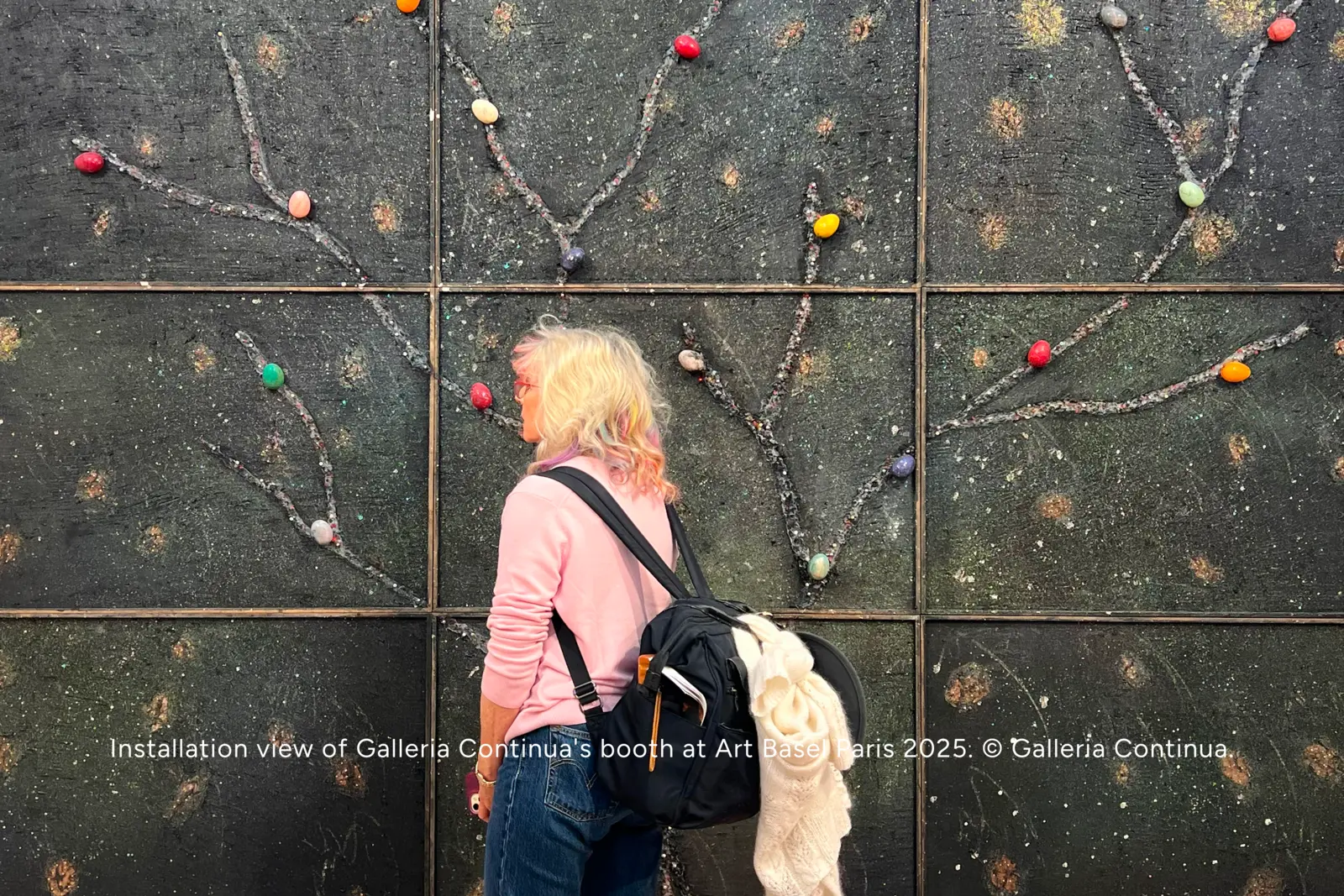
Across the booths, one could trace a clear thematic undercurrent: a focus on legacies that continue to define the standards and trajectories of the contemporary market. Many galleries deliberately juxtaposed works from the 20th century with new commissions, creating a sense of retrospective dialogue that ran throughout the fair.
This year introduced “Avant Première”, a new V.V.I.P. pre-preview at Art Basel Paris - an event accessible only to a few hundred of the world’s wealthiest collectors. Described by one insider as “the most exclusive art gathering on the planet,” it quickly became a cultural talking point. An Instagram meme quipped that it was easier to “break into the Louvre” than to get a ticket. Yet behind the glamour, Avant Première proved to be a decisive market moment: major deals were already closing within its first hours.
Among them, David Zwirner’s $7.5 million sale of a Ruth Asawa looped-wire hanging sculpture illustrated the continued revaluation of women modernists. White Cube’s placement of Julie Mehretu’s Charioteer (2007) for $11.5 million reinforced strong demand for major women painters in abstraction. Meanwhile, Gerhard Richter’s late-1980s yellow abstracts, jointly presented by Lévy Gorvy Dayan and Hauser & Wirth, fetched $25.5 million and $23 million, fueled by the concurrent Richter retrospective at Fondation Louis Vuitton.
Blue-chip names anchored the fair’s upper tier: Nahmad Contemporary’s solo presentation of nine Picassos, with two paintings selling for approximately $50 million each, marked the fair’s highest price points. Pace Gallery sold a 1918 Modigliani painting for just under $10 million, while Sprüth Magers placed two 2025 George Condo works at $1.8 million each, both snapped up rapidly amid high institutional visibility in Paris. On the emerging end, Karma International’s sale of Ida Ekblad’s Septic Sun (Painters Bench) (2025) for $120,000 reflected selective but confident acquisitions of younger European voices.
A single Picasso seemed almost obligatory this year, as his name surfaced repeatedly across the stands. Works by Modigliani, Rothko, Degas, Matisse, Gauguin, Louise Bourgeois, and Jean Dubuffet appeared beside contemporary signatures like El Anatsui and Yayoi Kusama. While some presentations embraced conceptual rigor, others projected an overtly commercial energy. Yet this contrast itself reflected the fair’s vitality: a marketplace alive with ambition for experimentation.
Among the galleries navigating 20th-century legacies and contemporary vision was Pace Gallery. Their booth spanned more than a century of art history, from Picasso and Modigliani to contemporary art collectives like teamLab. “On the booth we have work from 1907 up until 2025,” a Pace representative explained. “We have a very broad spectrum of dates and mediums.”
Historical blue-chip highlights included Modigliani’s Jeune fille aux macarons (1918) and Picasso’s Study for Nude with Drapery (1907), once part of Gertrude Stein’s collection, alongside Calder sculptures dating from 1946 and 1958.
When asked where the strongest interest lay, the representative noted that curiosity was evenly spread. “Honestly, a bit of everything. Our showcase is very carefully selected, so we really expect interest for every piece - and we do have interest for every piece. Of course people know the value of Rothko, Modigliani, and Picasso, so we have more questions and more people taking pictures. But overall, the interest is very broad.”
As for the fair itself, the atmosphere was unmistakably buoyant. “It’s very good,” the Pace representative remarked. “We were really happy - most galleries were happy about sales and attendance. I heard (but am not sure) it’s around 80% international guests. Art Basel really did a great job of bringing people to Paris - it’s not just French collectors here. And we did sell very well, as did many others from what I heard.”
Art Basel CEO Noah Horowitz acknowledged that the new ultra-exclusive format plays into Paris’s allure: “Demand for attending in Paris is exceptionally high. That bottleneck, in a way, adds to the magic.”
Beyond the Grand Palais, Paris’s art week extended into the city’s independent spaces, where parallel exhibitions deepened the week’s reflective tone. Among them, Fora Gallery presented 'Wandering Minds' (23–24 October, 48 rue de Lille, Paris 7) - a group exhibition featuring Shahnaz Aghayeva, Javid Ilham, Huseyn Jalil, Nazrin Mammadova, and Regina Rzaeva. The show examined the poetics of introspection, framing the act of mind-wandering as both a cognitive and creative process.