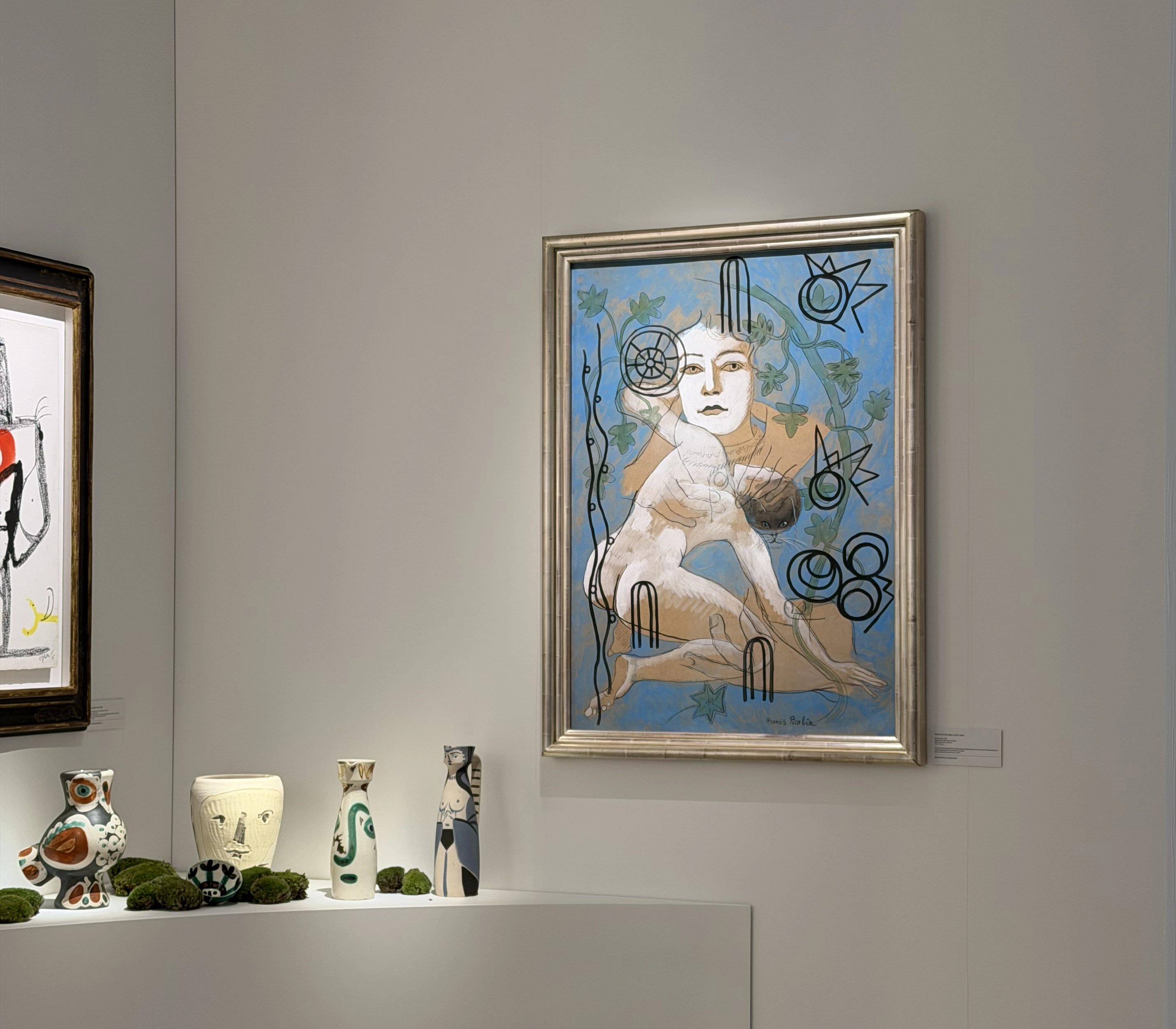
Visiting MAZE Art Gstaad during its invitation-only preview on February 19 situates the viewer within a clearly articulated collecting milieu. One appears already in dialogue with its audience, as the fair is shaped by seasonal return, shared reference points, and an implicit consensus around value. Movement through the Festival-Zelt follows a measured tempo, guided by focused viewing and close inspections. Gstaad itself functions as an active agent in this configuration, bringing together collectors, galleries, and patrons within a temporary but highly legible cultural ecology.
The audience gathered for the preview reflects a mature collecting demographic. Conversations progress through fluency in provenance, institutional validation, and secondary-market trajectories. Engagement with works is deliberate and sustained, oriented toward acquisition strategies grounded in experience. This concentration of expertise and purchasing capacity produces a cohesive, self-aware collective environment with long-term interests in artists, galleries, and the rhythms of the art market.
Now in its third edition, MAZE Art Gstaad presents an expanded spatial format,
growing from approximately twenty galleries to a configuration that includes an additional exhibition hall. Questions of scale and curatorial control emerged clearly this year, as the expansion is accompanied by careful modulation. The fair maintained visual clarity, allowing the expanded participation to register coherently. Circulation across levels remains fluid, as the conceptual framework supported a sense of continuity between presentations.
Privileging selectivity, the exhibition approach positioned works with attention to presence and space, aligning the fair with a salon logic and centering the selection on established artistic practices. Artists presented across the fair carry institutional standing, sustained exhibition records, and recognizable positions within contemporary and modern art discourse. Younger artists appear within this context exclusively with cohesive bodies of work and clear market trajectories.
Many galleries presented works already circulated through major European fairs,
particularly Art Geneva, foregrounding selections that had gathered visibility and collector interest. These selections indicate an emphasis on recognition, foregrounding works with demonstrated resonance among potential collectors. Across the fair, the alignment between artistic significance and market positioning remained explicit.
The fair’s geographic composition reflected a predominantly European orientation, with a strong presence of European and UK-headquartered galleries, complemented by a limited number of international participants and private collections. Asian galleries were not present, though Asian artists appeared through Western gallery programs.
Prices range from high five figures to several million,
situating MAZE Art Gstaad within an upper-tier collecting context. The distribution of price points accommodates established collectors engaging across different acquisition scales. The overall collector profile remained specialized, addressing a focus on advanced collecting practices.
The participation of galleries such as White Cube, Thaddaeus Ropac, Pace Gallery, Galerie Nathalie Obadia, Ketabi Bourdet, and Laffanour | Galerie Downtown underscores the fair’s institutional standing, for these galleries operate across major art capitals and engage selectively with fairs, considering their market priorities. Thus, their presence signaled a shared recognition of MAZE Art Gstaad as a site of concentrated collecting activity. Furthermore, the presence of prominent international patrons highlights the fair’s growing relevance.
Gstaad’s status as a winter destination additionally plays a crucial role in this alignment. The fair operates along the seasonal presence of collectors already present in the region. This convergence transforms the village into a temporary hub of cultural exchange, where leisure, collecting, and institutional discourse intersect within a controlled and discreet environment.
Attendance during the preview signals strong engagement across the public days, held from February 20–22, 2026, at the Festival-Zelt in Gstaad.
At Fora Gallery,
alongside our primary exhibition and curatorial program, we empower collectors and art enthusiasts by providing comprehensive information and expert guidance to navigate art fairs with confidence. From discovering standout works presented by leading galleries and collections, to advising on the most considered purchases and assisting with the acquisition process.
We act on behalf of our clients internationally, being present on-site, communicating directly with galleries, and supporting the purchase of works. We ensure a seamless and informed experience, offering support throughout every stage of our clients’ engagement.