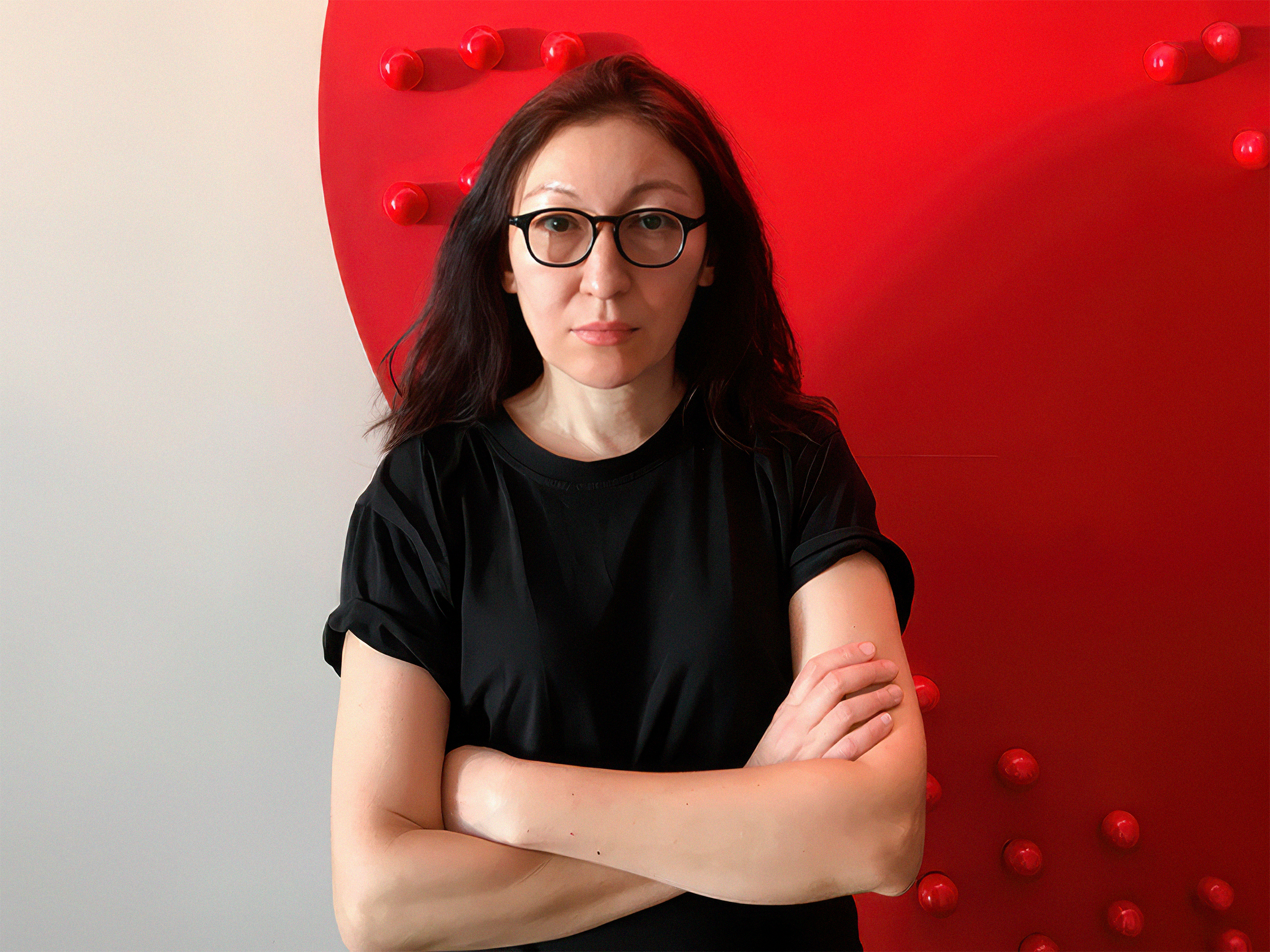
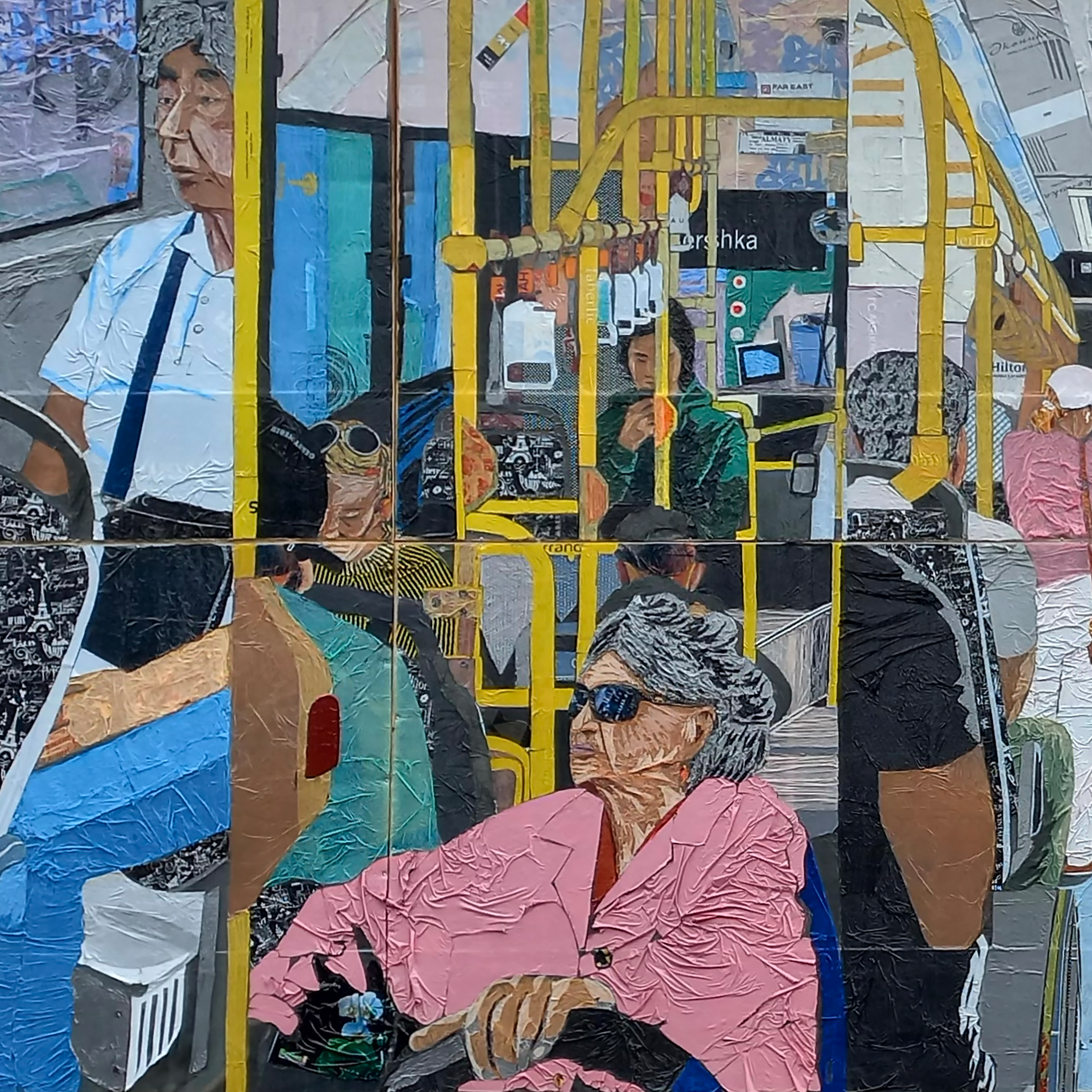
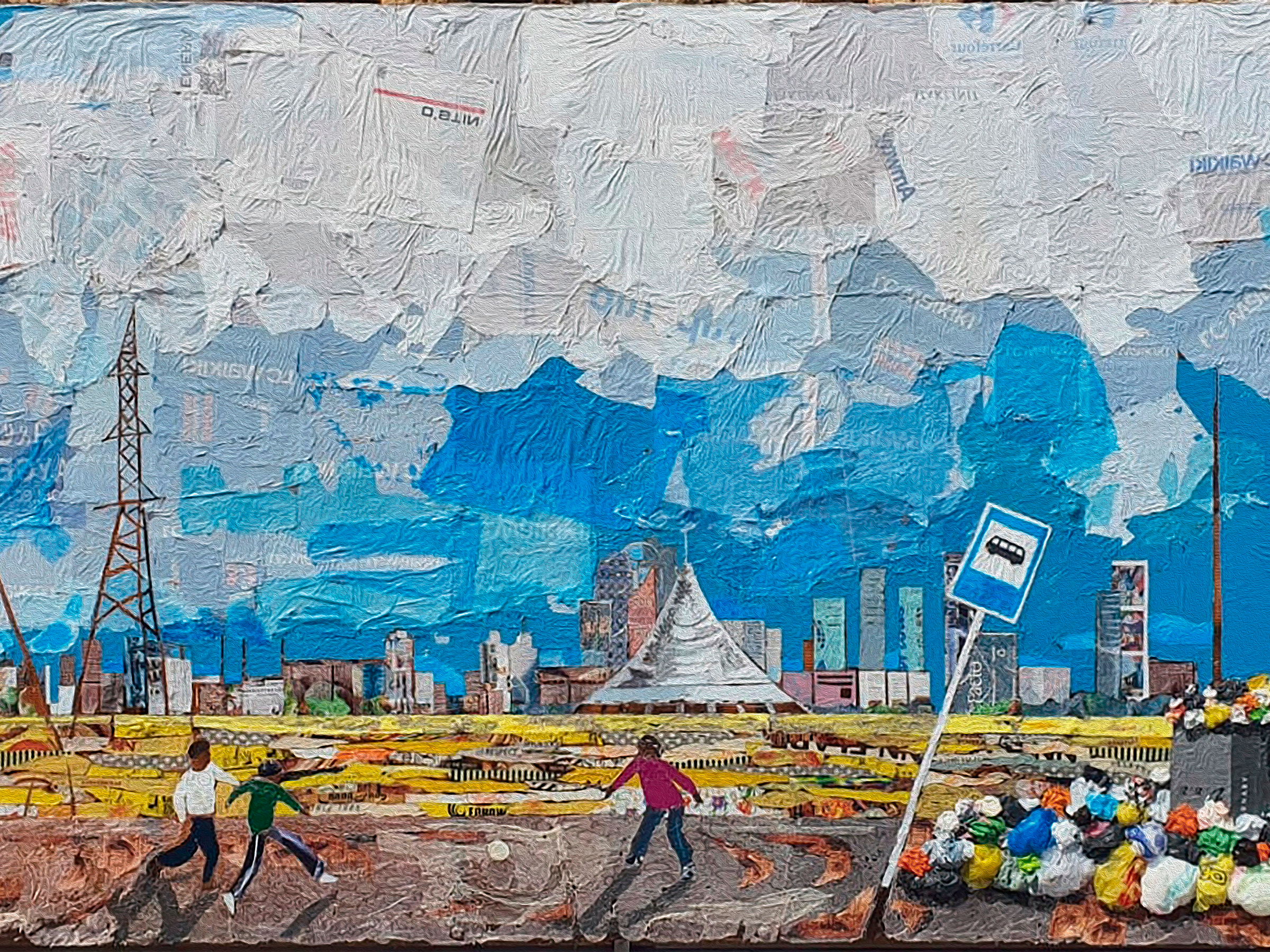
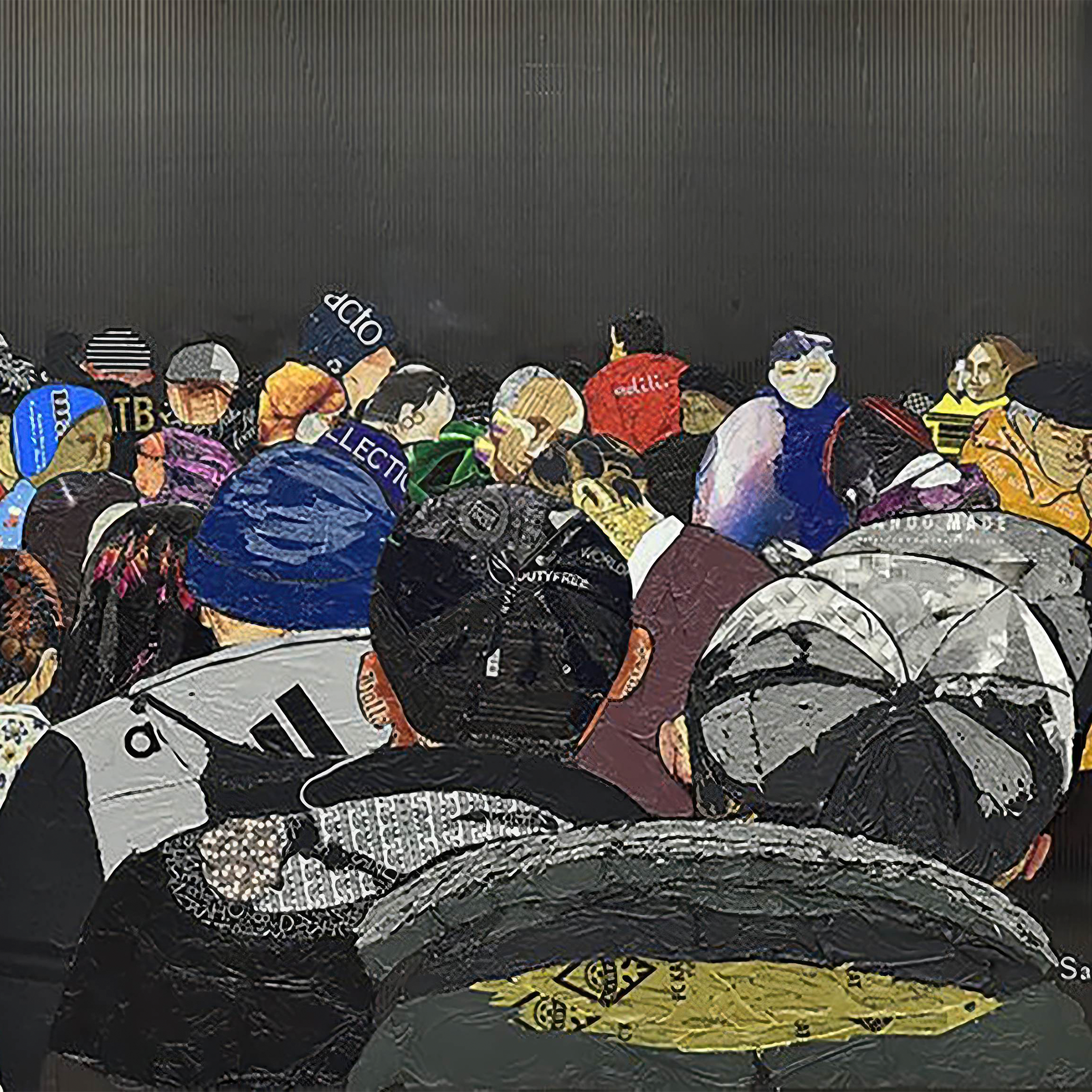
One of the central bodies of Saule Suleimenova’s practice is her ‘Cellophane painting’ series. Here, the careful extraction of each fragment of plastic - the search for a single, precise fold or the “perfect” cut of a bag - unfolds as a ritual. Shredded and reassembled, these surfaces cohere into layered, luminous landscapes where the through-lines of her narrative register more plainly. The artist works through trauma and memory, grounding her imagery in the subtle textures of daily life. Her compositions carry the spirit of the Kazakh steppe, and capture the limitless sky suspended in stillness above Almaty. She portrays a candid smile, fortuitously preserved in an archival photograph, and depicts an aching, untouched pain - the pain of the Kazakh past.
Born in 1970, Suleimenova graduated from the Kazakh Leading Academy of Architecture and Civil Engineering in 1996 with a degree in architectural design. From the outset, she has worked at the intersection of personal and collective memory, drawing on archival photographs, historical documents, and the layered contemporary semiotics with one clear ambition: to articulate a truthful image of Kazakhstan and its people.
The artist joins us for a conversation on art, identity, and the decolonial image in Central Asia.
When asked whether she feels a sense of responsibility as her work becomes the lens through which global audiences encounter Kazakh identity,
Suleimenova reflects on the early stages of her ‘Kazakh chronicle’ series. In the 1990s, as independent Kazakhstan’s art scene began to emerge, it did so within the noble traditions of socialist realism: complimentary, distant from reality. “That’s why I turned to archival photographs: because they are the documents of their time, and they don’t lie”, the artist explains. Her ambition was to construct a national idea, an image of Kazakhstan and its people, that was neither polished nor glamorous. “To show beauty where it truly exists”, she adds.
The challenge, she admits, remains immense. Suleimenova seeks a balance between beauty, non-idealization, and, above all, truth. She reflects on how to find the right tone without pathos, without fairy-tale narratives, yet without diminishing or belittling. There is no resting on laurels; with each new work, the same question resurfaces: “can it actually be done?”.
As the post-soviet region still carries residues of colonized consciousness - culturally, visually, psychologically - Suleimenova describes how her work navigates, challenges, and reconstructs these layered cultural legacies:
“The most devastating legacy we, as Kazakhstan, carry is a fractured sense of self-worth. That is a catastrophe, a truly profound one. All 15 former Soviet republics experienced this to some degree, but it was the nomadic cultures that endured the heaviest suffering. Stalin’s first directive was: in the Soviet Union, there are no nomads. And what happened as a result? Above all, the Great Famine, ‘Asharshylyk’, claimed nearly half of the population, and its most devastating legacy was the break in cultural memory. What we witness today is a newly engineered culture built on the ruins of what once existed. Today we are attempting to reconstruct something out of what little remains. We take “Soviet Kazakh” culture as a given, simply because there is so little else to lean on”.
Asked about the notion of “another Kazakhness”,
beyond clichés and official aesthetics, Suleimenova gestures toward “an epic sense of life” inherent to her culture. Perhaps it is “the great steppe”, she suggests, that “belongs to us” and shapes this sensibility. “When people ask me if I have a political stance on something, I say: I have feelings, I have a deep, terrible pain, and I want to convey it, to share it, because I think I am not the only one who feels this pain. I think it’s something that unites all of us”, she says. For her, everything is rooted in a fundamental emotion, a primary feeling of love. “I love our people very much - they are wonderful as they are”. Moments of trauma, she notes, reveal the character of the people with particular clarity. The Jeltoqsan protests, she recounts, exemplify this energy: Kazakh youth, largely from villages, spontaneously took to the streets in terrible cold, in frost, thousands in number. “It was epic energy. It reflects Kazakhness very well”.
As we turn to the misrepresentations of Kazakh history and colonial narratives, Suleimenova underscores the inextricable nature of this legacy: “It is integral to who we are, impossible to extract or undo. My daughter has an absolutely brilliant video project called ‘Decolonization of Kurt’. She takes kurt, our traditional salted cheese, and tries to infect the kurt with mold. And kurt, as a product of nomadic life, is almost impossible to spoil or mold; it is intentionally made to last for years. However, on the third or fourth attempt, she finally succeeds. But the next step is to remove the mold. And the mold cannot be removed - even if it looks like it’s only on the surface. The video ends with the phrase: “Decolonization failed. Fatal error.” Because it’s not possible, it has already fused with our identity. We cannot cut it out”.
The artist’s material practice is equally tied to memory and transformation.
Her ‘Cellophane painting’ series emerges from earlier practices, drawing on the poetry of the everyday - not the glossy surface, but what lies beneath. The material resonates with quraq korpe, the traditional Kazakh patchwork quilt. “Why don’t we love the trash that comes from us? We prefer not to see it… But that’s us too”, she observes. To her, this is the essence of decolonization: accepting oneself entirely, even the traces one leaves behind.
Archival photographs remain central to her work. Initially drawn to the sepia tones and faded textures, Suleimenova was captivated by their documentary potential. Unlike staged studio portraits, these images record people in their natural environments. “They show people as they were before”, she says. In this sense, her own work becomes a kind of archive, a visual document that cannot be rapidly reproduced.
On the notion of a shared “cultural code”,
Suleimenova expands the lens beyond Kazakhstan: “It inspires me deeply, when I travel, for example, to Baku, Bishkek, or Bukhara. Not so long ago we didn’t have these rigid borders. Our cultures flowed into one another, and to varying degrees we were all connected. Kazakh culture cannot be torn out of this context or presented as something isolated and separate; it exists within this entanglement”, she notes.
The artist’s engagement with the Bukhara Biennial exemplifies this approach. She describes the city as the very quintessence of our shared cultural code: “In Bukhara, you can trace how intertwined our cultures are. In my work, I wanted to capture this feeling. I structured my dialogue with Bukhara, around intersections: old and young, new language and ancient culture, and love - everything that connects them. It’s this very intersection that creates Bukhara, Bukhara as a crossroads”, she says.
We asked the artist about the Kazakh decolonial perspective and its contribution to the global cultural dialogue.
The decolonial perspective, she insists, is difficult to capture in words: “which is why artists often take the lead: visual language communicates more powerfully than text. I’m excited that the global art community is paying attention to our region. We are simply telling our own story, and first and foremost, we are interesting to ourselves. The emergence of strong, supportive institutions has legitimized our years of experimentation, and as we take pride in our work, the world takes notice”, Suleimenova notes.
As for the growing interest of European collectors in Central Asian art, the artist highlights the role of major collections in building an independent history of the region: “I think that acquisitions, particularly of my work, help these collections build an independent history or biography of the region. I believe that major international collections help establish a timeline or understanding of our region and its art space. After Russia’s actions, the veil over our region has lifted, revealing a wide range of completely independent directions, self-sufficient and not needing to be represented through Russia”.