
‘Isolated Realities’ сurated by FORA Gallery’s exclusively represented artist Huseyn Jalil opens with a single line of black type: “We apologize for the temporary inconvenience. The entire production budget for this installation has been redirected to wildlife conservation.”
Jalil’s meta-work is the first interactive installation visitors meet on entering the Fluxus Space. It addresses the viewer directly, asking what an artist and the art world can do for the natural world beyond making art about it.
That question runs through the whole exhibition, as Jalil takes on the dual role of curator and participating artist, and the project extends his practice into conceptual framing. It is his first full curatorial undertaking after several co-curated shows. ‘Isolated Realities’ is a sustained investigation into how art can approach ecology, built on six months of research, archival work and fieldwork in Azerbaijan’s national parks. For an artist long drawn to living organisms, to the logic of natural systems and to the way structures form and sustain themselves, it marks a decisive point in a long line of inquiry.
The opening piece puts its message into practice. The production budget allocated to it went to WWF Azerbaijan, a direct partnership within the project. The work can still be acquired, and the full payment from every sale goes to the same conservation fund. When the exhibition closes, the sign will be disposed of and cease to exist, leaving no object to keep on a wall, only the effect of the gesture. The work examines whether art can truly help the environment by committing its own resources to it.
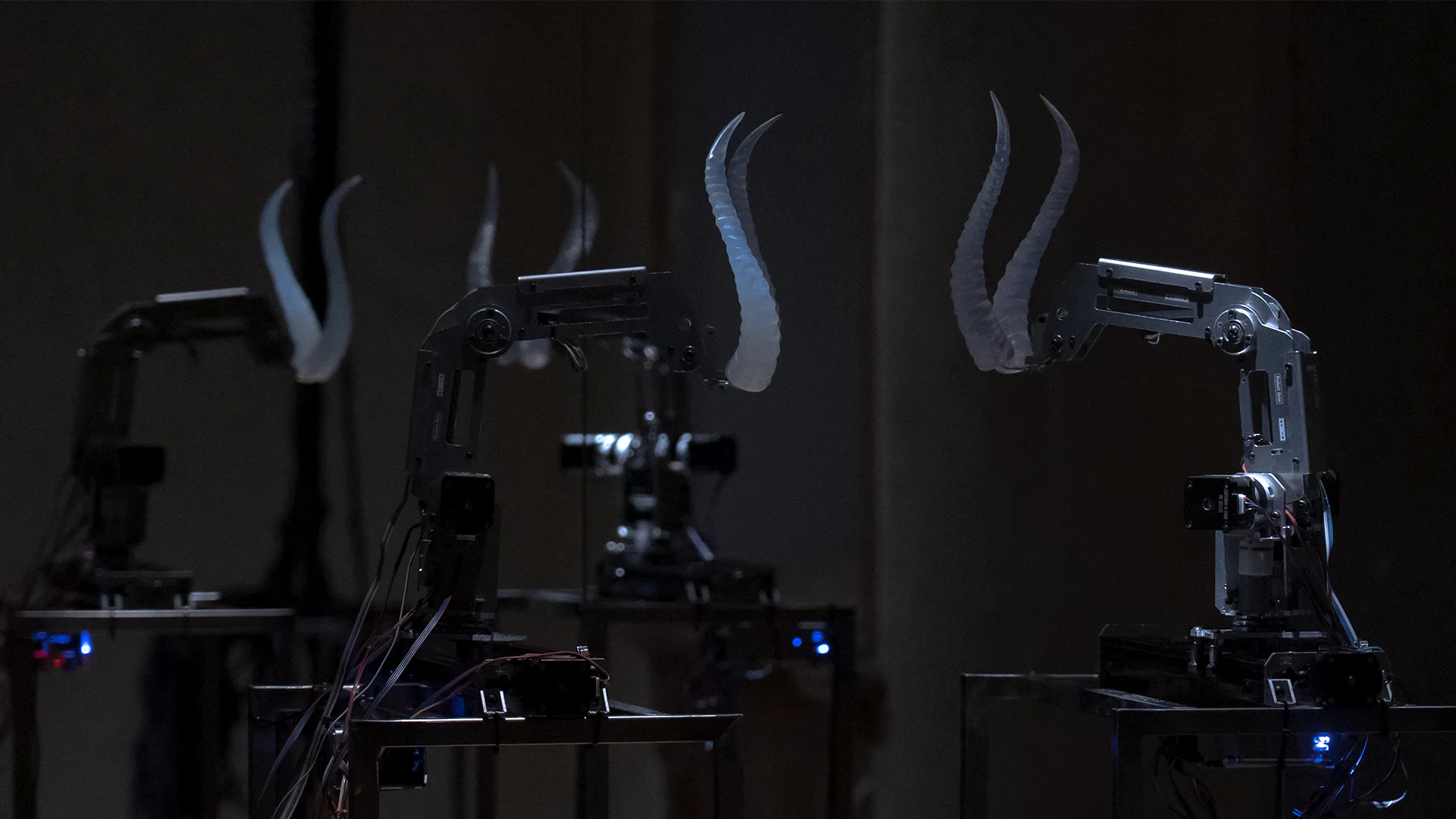
Jalil’s next piece on view, ‘Kinda Conflict’, moves from that question to the animals themselves and how they behave toward one another. It is a mixed-media construction of two robotic “gazelles” set against each other in competition. The artist does not present a complete image of the animal. Each machine is a pair of scanned antlers, mounted on a mechanical frame and aimed at the other.
The piece grew from the project’s visits to national parks, where the team and participating artists observed and recorded male goitered gazelles competing almost constantly. The animals change behavior abruptly and begin to fight, and the first sign of it is one humans are not used to recognizing, since we do not read their body language. Jalil studied these patterns and translated them into an algorithm he wrote himself. The two machines can see each other’s code and know how the other will move, so they perceive the connection that exists in nature but stays invisible to us. The code is written continuously through their interaction, and during the exhibition.
The antlers are 3D-printed in transparent resin from scans of real gazelle horns, drawing on the photographs, video and other material collected during the research. Jalil chose transparency to create an alternative, nonstandard image of the animal. The surfaces show scratches from the machines’ collisions, a record of contact that echoes the confrontations of the natural world.
The exhibition continues with FORA Gallery-represented artist Nazrin Mammadova’s ‘Indeterminate Presence’, an audiovisual sound performance that questions where the boundary between an organism and its environment lies.
Developed through field research in Zangezur National Park in Nakhchivan, the work places sound at its center. To reach what a visitor to the park would never hear, Mammadova recorded with specialized microphones that capture frequencies beyond the range of the human ear. She also scanned the terrain where she recorded, including an entire mountain, and those scans shape the visual side of the work.
She then fragmented and layered the recordings and scans, detaching them from their original context and reorganizing them into an abstract sensory landscape. The work draws on acoustic ecology, experimental music, soundscape studies and the concept of aural diversity, the multiplicity of individual listening experiences. It treats sound as material, listening as a way of knowing, and landscape as a subjective construction. The work builds a perceptual space where organism, environment and observer become increasingly hard to tell apart, and immerses the viewer in a reality that is naturally neither visible nor audible to them.
Further into the exhibition,
Elnara Nasirli’s ‘AQUILA’ explores the transmission of inherited knowledge through the figure of the eagle and the idea of hair as a carrier of memory. Combining the braids collected by the artist over the past years with branches from a dying tree, the installation reflects on continuity and transmission of knowledge as a condition of survival that extends beyond the human experience. The space then opens into the next visual section featuring Emin Mathers and Timur Zaripov. Mathers’s photographic research installation, employing camera traps and thermal imaging, considers the perceptual world of the Caucasian brown bear. Zaripov’s multimedia installation examines the impact of technology and artificial intelligence on the environment, while his three-channel video renders local forest biotopes through the sensory apparatus of a fruit fly.
The visual presentation of the show spotlights the curator’s main points of interest in the project.
Jalil keeps the space dark and the lighting weak, close to the hours when forests and wildlife reveal their patterns, at night and in the early morning. The darkness also puts the visitor in a position of vulnerability, where dominance over the environment gives way to being a living part of it.
The project encompasses a wider program of research and collaboration. Material and data collected throughout the on-site and off-site research will pass to the archives of local organizations and institutions, as well as to the artists’ further professional use. Much of the exhibition relies on recycled and upcycled materials. The presentation closes with a film shot in the three national parks the team visited.
Jalil’s premise is that research and scientific data alone do not always reach the public or give an issue the attention it needs, and that art can carry it further. Each artist drew a different approach from the six months of fieldwork, through emotion, sound, image, data or material, and the range of media reflects it. FORA Gallery has followed Huseyn Jalil’s interest in biology and natural systems throughout his practice. With ‘Isolated Realities’, that interest now informs curatorial research and collaborative, regionally grounded inquiry alongside his individual works.
‘Isolated Realities’ is a group exhibition and research project produced by Fluxus Space, created with the institutional support of WWF Azerbaijan and the Ministry of Ecology and Natural Resources of the Republic of Azerbaijan, and is presented as part of Fly to Baku. Art Weekend. Sense the Future NOW.